Local Transits
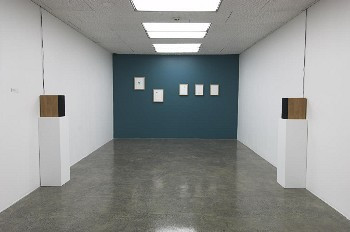
Jennie C. Jones, Transposed Blue/Cool: For Miles & Juliette, 2006, audio collage, 5 works on paper.
Photographer: Jennifer French
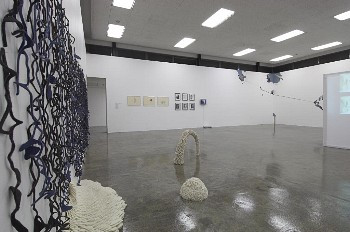
Installation view of Local Transit - An exhibition in two parts.
Photographer: Jennifer French
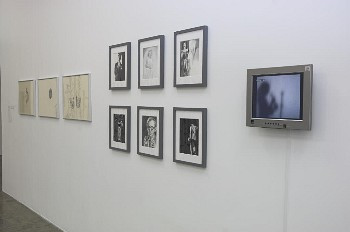
Local Transit, 2006
Sara Greenberger Rafferty, Moms Mabley – “Moms Wows” Chess LP-1486 (1964), 2006, pencil on paper.
Hudson and Landry – “Hanging in There” Dore LP 324 (1971), 2006, pencil on paper.
“The Wonderful World of Jonathan Winters” Verve MG V-15009 (1960), 2006, pencil on paper.
George, 2006, water soluble wax pastel on paper. Phyllis, 2006, pencil on paper.
Elaine and Mike, 2006, water soluble wax pastel on paper. Dick, 2006 charcoal drawing.
Woody, 2006, pencil on paper. Richard, 2006, water soluble wax pastel on paper. Random, 2006, DVD.
Photographer: Jennifer French
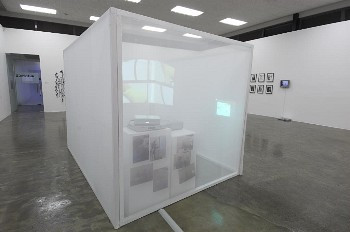
Kylie Duncan with Keely O’Shannessy and Gerald Phillips, Operation.001, 2006, performance / video
Photographer: Jennifer French
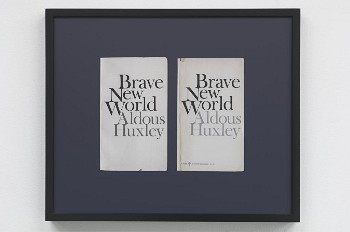
Lisa Tan, Two Brave New Worlds, 2006. c-print
Courtesy of Grimm|Rosenfeld, Munich and New York
Photographer: Jennifer French
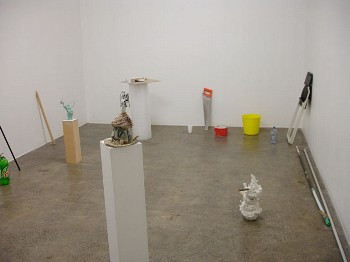
Dan Arps, A Centre for Ants, 2006, various media
Image by the artist
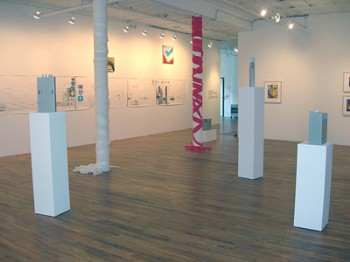
Installation view of Local Transit, Artists Space, New York
Ri Williamson
Daniel Malone
An exhibition exchange, jointly organised by Artists Space, New York and Artspace, Auckland, Local Transit. Alluding to the question of translations and readings/misreadings.
Dan Arps
Kylie Duncan
Simon Esling
Jennie C. Jones
Jennifer Nocon
Sara Greenberger Raffery
Blake Rayne
Sriwhana Spong
Lisa Tan
What does it mean to be in New York compared to Auckland or Los Angeles? Does being in a perceived geographical periphery such as Auckland presuppose "misreadings" of dominant trends? And does New York's cultural status decide the conversation and presume only "readings"?
Co-curated by Artists Space Curator at the time, Christian Rattemeyer and Artspace Director at the time Brian Butler, Local Transit originates from the recognition of the two institutions' similar history, size and role in their respective communities. The exhibition occurs concurrently in Auckland and New York. In each location a different group of artists was selected: four Aucklanders, four New Yorkers and one Angelino.
Through the exchange of artists Local Transit investigated the complexities of locating and reading contemporary art. All the artists hail from port cities. Traditionally, these are free cities with a lack of control in what passes through and enters the port. Local Transit also questions whether Auckland, Los Angeles and New York continue to operate as port cities, places where ideas flow and meanings are difficult to fix.
Informed by an interest in architecture and anatomy, Simon Esling produced a wall painting directly in dialogue with the architecture of the corner wall. The tension of anatomical structure is abstracted at this scale, forming a nebulous landscape that is as much about the act of painting as its form.
Sara Greenberger Rafferty's drawings of caricatures question the recognisable language of slapstick and stand-up comedy. Like the comedian's act, where tension is pivotal to the success of humour, the works seem suspended between the familiar and the unexpected. This tension is compounded by the video work Random (2006), which captures the silhouette of the artist performing as a comedian.
The hand-dyed, wool-felt sculptures of Jennifer Nocon, form open intuitive patterns that have a visual language all of their own. As though determined by its very material, the work Black and Blue (2006) unravels and writes across the wall, while Failure to Launch (2006) moves out into the space remnant of an attempt and a pile of its own making.
Collaborating with Keely O’Shannessy and Gerald Phillipps, Kylie Duncan formed a video operation - a video performance that intercuts between pre-recorded footage, sound and the live act of performance. The evidence of the performance is left as a sculptural projection showing documentation of the event. The work is comprised of a series of switching views, complicating the documentation process to emphasise the act of viewing as characterized by compromise and uncertainty.
Lisa Tan's practice distills issues of reciprocity and intimacy into a concise and highly constructed formalism. Punctuating three sites around the gallery, Tan's photographic series of books document the overlap that occurred when she and her partner moved to New York and combined libraries. The sentimentality of these post-conceptual works can be seen as connecting to a deeply personal negotiation while also paying homage to a post-modern doubling.
Sriwhana Spong's new work Peace Mantra (2006) references the social-historical moment of the 1960s peace movement. These sculptural mantras investigate the complexity of cultural symbols and collective memory, and in doing so questions how the peace sign has become loaded with new implications and nostalgia.
Jennie C. Jones captures a historical moment of exchange between Miles Davis and his lover Juliette Greco, the singer, poet and friend of Jean-Paul Satre. The two music compositions of Jones' audio collage, Greco's Je suis comme je suis (I am as I am) and Davis's Blue Room are edited so the tracks trade places from left to right speaker during playback. This transposition of place represents the convergence of Davis and Greco's relationship, which is further reflected in the use of line and motif in the five works on paper.
Exploratory in the inherent relationship to substance that painting allows, BLAKE RAYNE complicates the visceral by referencing the photographic process. What ensues is an atmospheric, gestural surface that is based on an investigation of modernist painting and its crossings with the development of photography.
Dan Arps confounds the object to question its sculptural potentiality. A Centre for Ants (2006) allows the sculptural objects to play-up if it be through the elevation of the plinth, the aggression of armoured spikes or the proclaimed mark of good-use. In entering its contained space, the work calls on an intimate viewing and gives a sense that each sculpture awaits its animation.
See available works by Jennifer Nocon, Dane Mitchell, and Daniel Malone.
Artspace would like to acknowledge the generous support from Tim Nye and Aviva Covitz